

When people talk about the future of Power BI today, the discussion is often dominated by topics such as:
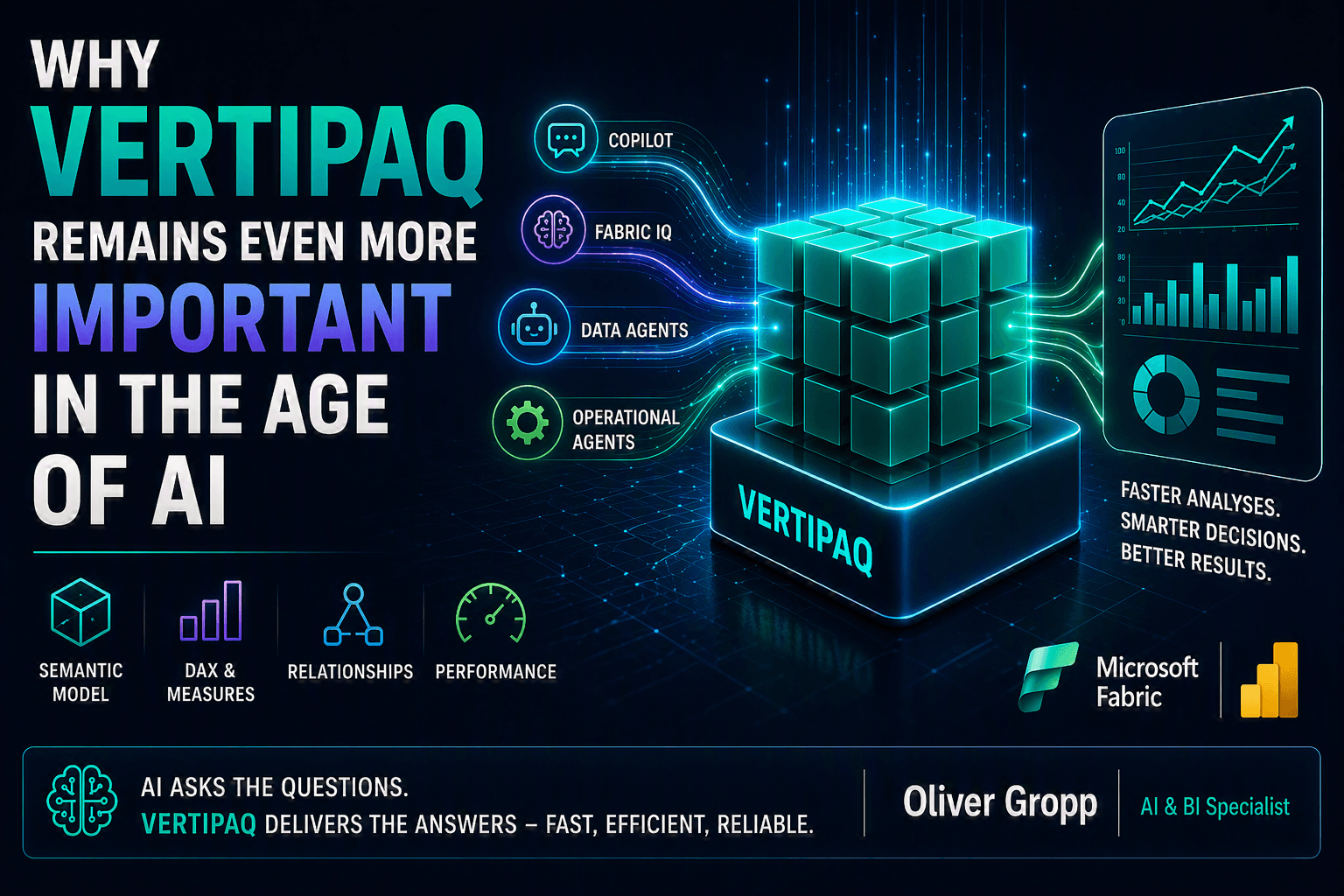
- Copilot
- Fabric IQ
- Data Agents
- Operational Agents
- Generative AI
At the same time, I have the impression that one fundamental topic is gradually fading into the background:
VertiPaq
Some developers are even starting to believe that traditional data modeling and VertiPaq optimization will become less important in the future. After all, AI is taking over more and more tasks.
Or is it?
I believe this will only happen to a certain extent. Because if I do not understand what should be optimized, I cannot properly support or guide AI.
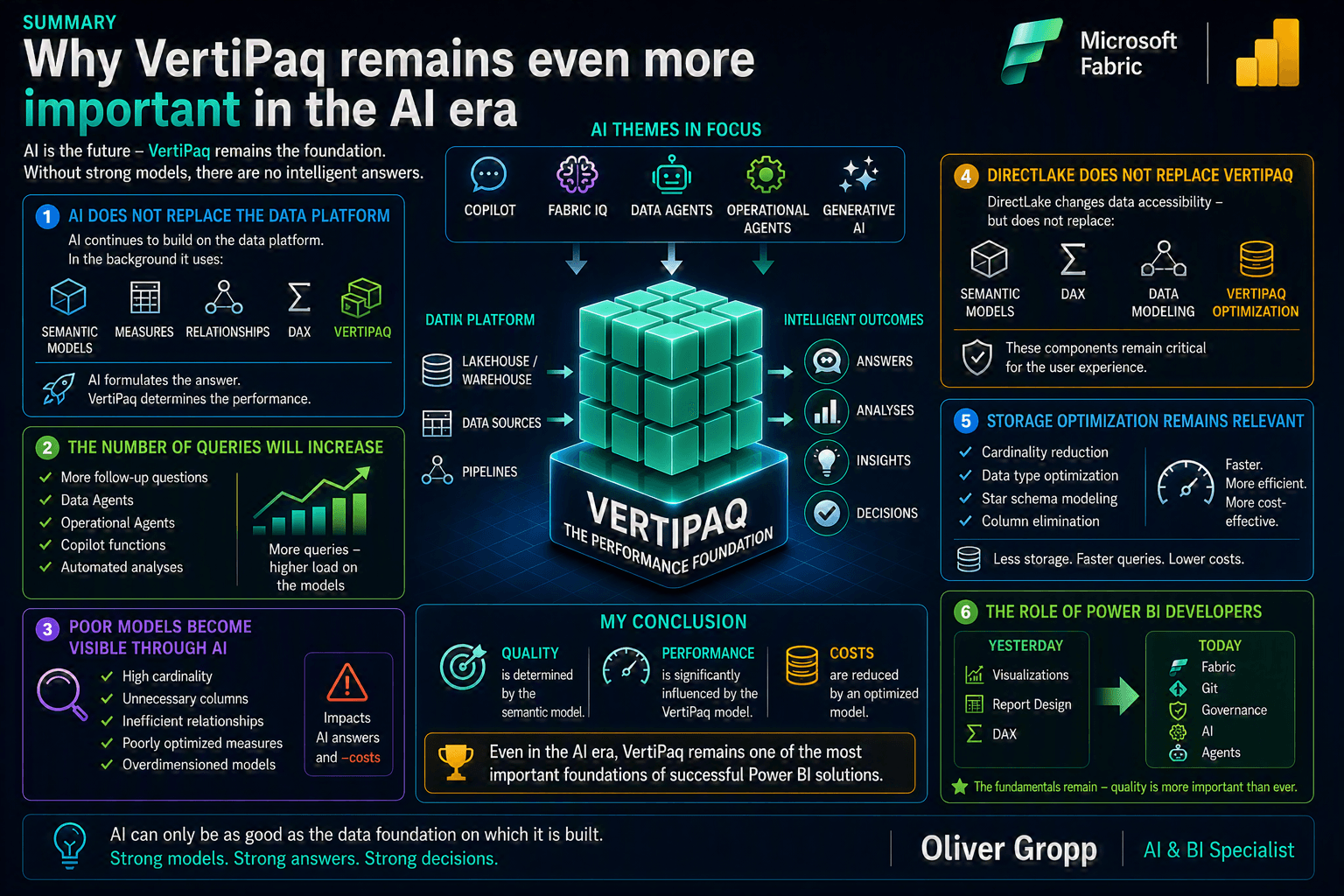
AI Does Not Replace the Data Platform
Many people view AI as an intelligent layer that communicates directly with enterprise data.
The reality looks quite different.
When a user asks Copilot a question, for example:
"How has our revenue developed compared to last year?"
The AI does not operate independently from the data platform.
Behind the scenes, the system still relies on:
- Semantic Models
- Measures
- Relationships
- DAX
- VertiPaq
AI formulates the answer.
However, the actual data foundation continues to be provided by the Semantic Model. And the performance of those underlying queries is heavily influenced by VertiPaq.
The Number of Queries Will Increase
In the past, a typical usage pattern often looked like this:
- Open a report
- View a visualization
- Close the report
With AI, this behavior fundamentally changes.
A user may now ask several follow-up questions:
- Why did revenue decline?
- Which regions are affected?
- Which products had the greatest impact?
- How does the trend compare to last year?
Each of these questions generates additional queries against the Semantic Model.
On top of that, organizations increasingly use:
- Data Agents
- Operational Agents
- Copilot capabilities
- Automated analyses
As a result, the number of model queries is far more likely to increase than decrease.
And with that, the importance of high-performing data models becomes even greater.
Poor Models Become More Visible Through AI
Another aspect is frequently underestimated.
AI does not fix poor data modeling.
It simply exposes its weaknesses.
Challenges such as:
- High-cardinality columns
- Unnecessary columns
- Inefficient relationships
- Poorly optimized measures
- Oversized models
will continue to exist.
The difference is that while previously only individual reports may have been slow, these same problems can now directly impact AI-driven workloads and related costs.
The more frequently a model is used, the more obvious its weaknesses become.
DirectLake Does Not Replace VertiPaq
When discussing Microsoft Fabric, I often hear the statement:
"With DirectLake, VertiPaq becomes less important."
I believe this is a misconception.
DirectLake primarily changes the way data is accessed and delivered.
It does not replace:
- Semantic Models
- DAX
- Data modeling
- VertiPaq optimization
Even in modern Fabric architectures, these components remain essential for delivering a high-quality user experience.
Why Memory Optimization Remains Relevant
The strength of VertiPaq is not limited to speed.
Its compression technology also enables large data volumes to be processed efficiently.
Therefore, topics such as:
- Cardinality reduction
- Data type optimization
- Star schema modeling
- Column elimination
remain important aspects of professional Power BI development.
Particularly in enterprise environments with large user bases and increasing AI adoption, proper VertiPaq optimization can have a substantial impact on both performance and resource consumption.
The Role of the Power BI Developer Is Changing
Historically, the primary focus was often on:
- Visualizations
- Report design
- DAX
Today, new responsibilities are being added:
- Fabric
- Git
- Governance
- AI
- Agents
However, the foundations are not disappearing.
Quite the opposite.
The more intelligent systems access a Semantic Model, the more important the quality of that model becomes.
My Conclusion
The current AI discussion sometimes creates the impression that traditional topics such as data modeling and VertiPaq are losing importance.
From my perspective, the opposite is true.
While the quality of AI-generated answers increasingly depends on Semantic Models, metadata, and business logic, the speed—and therefore the cost—of those answers continues to be influenced by the underlying engine.
And when it comes to cost optimization, VertiPaq will continue to play a major role. A well-optimized model will consume fewer resources and generate lower costs than a poorly designed one.
And that is exactly where VertiPaq becomes critical.
My belief is simple:
The quality of AI is determined by the Semantic Model.
The performance of AI is heavily influenced by the VertiPaq model.
Anyone exploring Copilot, Fabric IQ, and AI agents today should therefore not lose sight of the fundamentals.
Because even in the age of AI, VertiPaq remains one of the most important foundations of successful Power BI solutions.