

Why Fabric IQ Could Change the Future of AI in Enterprises
When people talk about AI in enterprises today, the focus is usually on topics such as Copilot, chatbots, or agents.
What is often overlooked, however, is that the real challenge is not the AI itself. The actual problem is:
How does an AI understand the business meaning of enterprise data?
This is exactly where Microsoft’s Fabric IQ comes into play.
In my view, Fabric IQ could eventually become just as important for AI as Semantic Models are for Power BI today.
The Core Problem of Modern Data Platforms
Most companies today already have:
- Data Warehouses
- Lakehouses
- Semantic Models
- Reports
- Data Pipelines
- Business Applications
The data exists.
What is often missing is a shared business understanding.
Take the term "Customer" as an example. At Deutsche Bahn, for instance, almost every business unit has a different definition of a customer or uses related synonyms such as "Partner."
For humans, these differences are usually understandable.
For an AI, however, they are not.
An AI initially only sees:
- Tables
- Columns
- Relationships
- Measures
It does not automatically understand the business meaning behind them.
What Is Fabric IQ?
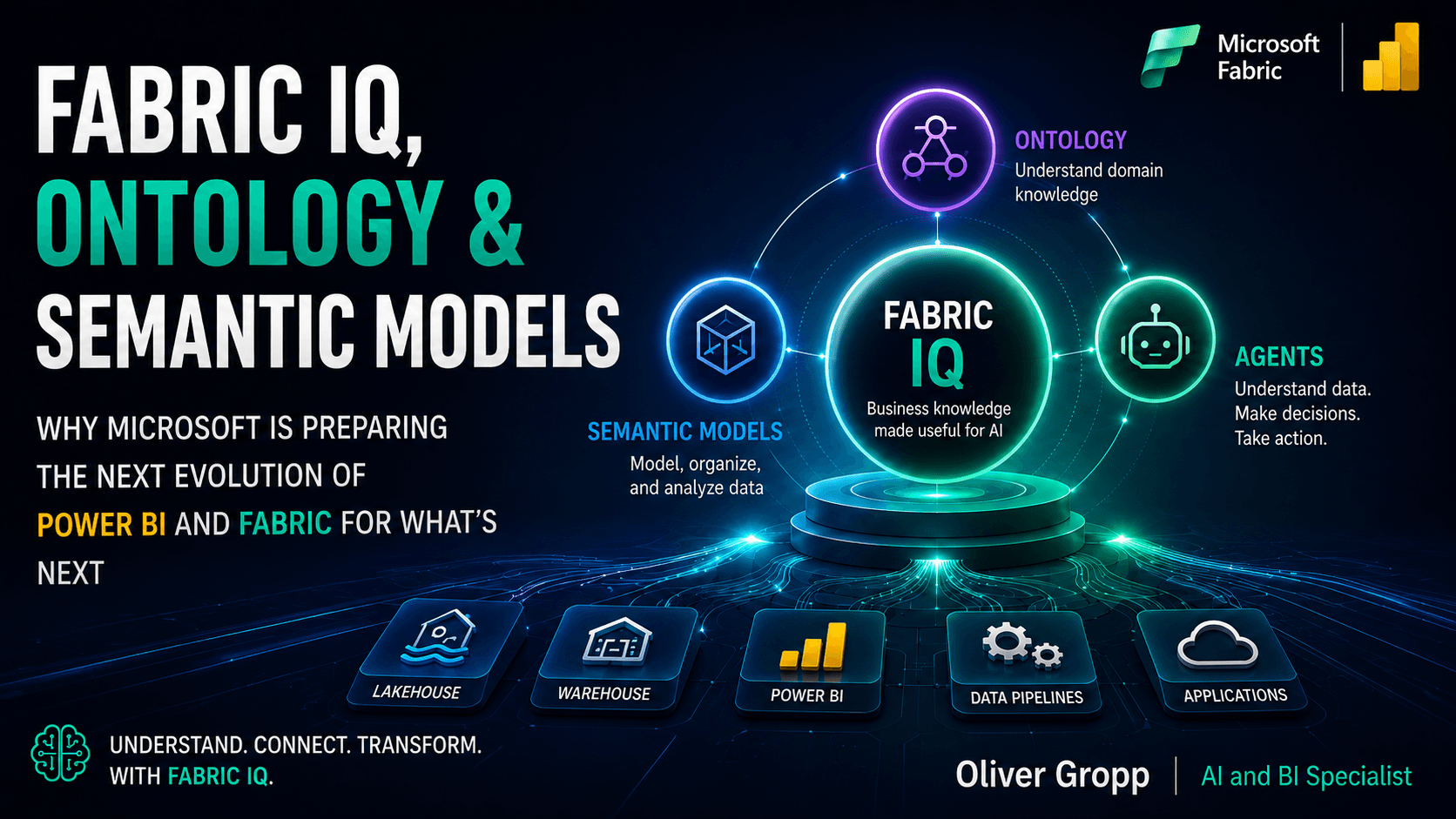
Fabric IQ is Microsoft's approach to bringing enterprise knowledge, data, and AI closer together.
Its primary focus is not data storage or reporting.
Instead, it is about providing AI systems with additional business context.
Fabric IQ combines:
- Semantic Models
- Ontologies
- Knowledge Graphs
- Data Agents
- Operational Agents
- Fabric data sources
into a shared knowledge foundation.
The Goal
Not only to understand data, but to understand the business itself—and potentially break it down into smaller ontologies.
The Role of Ontology
An ontology describes the business language of an organization.
It defines:
- Business objects
- Relationships
- Processes
- Business rules
- Business definitions
For example:
- Customer
- Order
- Product
- Train
- Delay
- Revenue
An ontology does not simply describe individual objects. It also captures their relationships.
This creates a digital representation of business logic across multiple layers.
Why Semantic Models Remain the Foundation
One important aspect is often misunderstood.
Many people believe that ontology will replace Semantic Models.
That is not the case.
Semantic Models remain the central foundation for:
- Measures
- Relationships
- Calculations
- Reporting
- Self-Service BI
In reality, Fabric IQ extends existing Semantic Models with an additional business layer.
A simplified way to think about it is:
Semantic Model = How data is analyzed technically
Ontology = What the data means from a business perspective
These concepts complement each other—they do not replace each other.
Together, they allow AI to see the bigger picture that would otherwise need to be repeatedly provided through context, system prompts, instructions, steering mechanisms, and similar approaches.
Data Agents – AI for Analytics
Data Agents operate on top of existing data assets.
They can:
- Answer questions
- Analyze metrics
- Identify trends
- Explain relationships
- Combine information from multiple data sources
Examples
"How have revenues developed compared to last year?"
"Which regions have the highest delay rates?"
The key difference from traditional queries is that the agent does not rely solely on table structures.
It also utilizes knowledge from the ontology and Semantic Model.
As a result, answers become significantly more accurate from a business perspective.
Operational Agents – AI for Processes
Operational Agents take things a step further.
They do not just analyze data—they support operational workflows.
Typical Scenarios
- Process monitoring
- Anomaly detection
- Notifications
- Automated actions
- Decision support
While Data Agents provide information, Operational Agents help organizations act on that information.
Why Metadata Suddenly Becomes Strategic
With Fabric IQ, the importance of Semantic Models changes significantly.
Until now, many model elements were maintained primarily for reporting purposes.
These include:
- Descriptions
- Synonyms
- Business definitions
- Documentation
Many developers viewed this information as optional and maintained it only minimally.
For AI, however, it becomes essential.
Personally, I have always considered metadata in Semantic Models to be extremely important because I viewed it as part of the documentation and as support for self-service users.
Why Synonyms Become Important
People rarely speak using technical model names.
A business user might ask:
"How many customers did we have last quarter?"
However, the model may contain objects named:
- Customer
- Customer_ID
- CustomerKey
Synonyms help AI connect business language with technical objects.
The better these are maintained, the better AI can understand the true intent behind a question.
Why Descriptions Become More Important
Consider a measure called:
Delay Rate
For a developer, the meaning may be obvious.
For an AI, it is initially just a name.
The description provides additional context:
- How is the metric calculated?
- Which business rules apply?
- What exceptions exist?
- For which use case was it created?
This information significantly improves the quality of responses.
The New Role of Power BI Developers
With Fabric IQ, the focus shifts.
Historically, developers mainly concentrated on:
- DAX
- Visualizations
- Performance
Going forward, additional topics become equally important:
- Business modeling
- Metadata management
- Synonyms
- Descriptions
- Business glossaries
- Governance
The quality of AI depends directly on the quality of the underlying Semantic Models.
As described earlier, metadata improves access for Fabric Agents.
However, it also benefits tools such as:
- Claude
- GitHub Copilot
- Kiro
during local development because these AI systems can also access metadata contained in the PBIP format.
My Conclusion
Fabric IQ is far more than just another AI feature in Microsoft Fabric.
It is an attempt to close the gap between data and business knowledge.
This creates an ecosystem consisting of:
- Semantic Models
- Ontology
- Data Agents
- Operational Agents
- Enterprise knowledge
What I find most interesting is that many companies are currently investing heavily in AI assistants and agents.
Yet the real success factor is often overlooked:
An AI can only be as intelligent as the data, definitions, and metadata on which it is built.
That is exactly why Semantic Models, synonyms, descriptions, and governance will become significantly more important in the coming years.
Not only for reporting.
But as the knowledge foundation for the next generation of AI-powered applications in Microsoft Fabric.