

When I first introduced PBI Documentation, the goal was simple: make Power BI and Microsoft Fabric documentation effortless.
Since then, I have received a lot of valuable feedback from the community and implemented several highly requested features. The latest release significantly expands the capabilities of the tool and makes it even more useful for developers, architects, governance teams, and organizations that want to improve transparency and knowledge sharing across their BI landscape.
🚀 What's New?
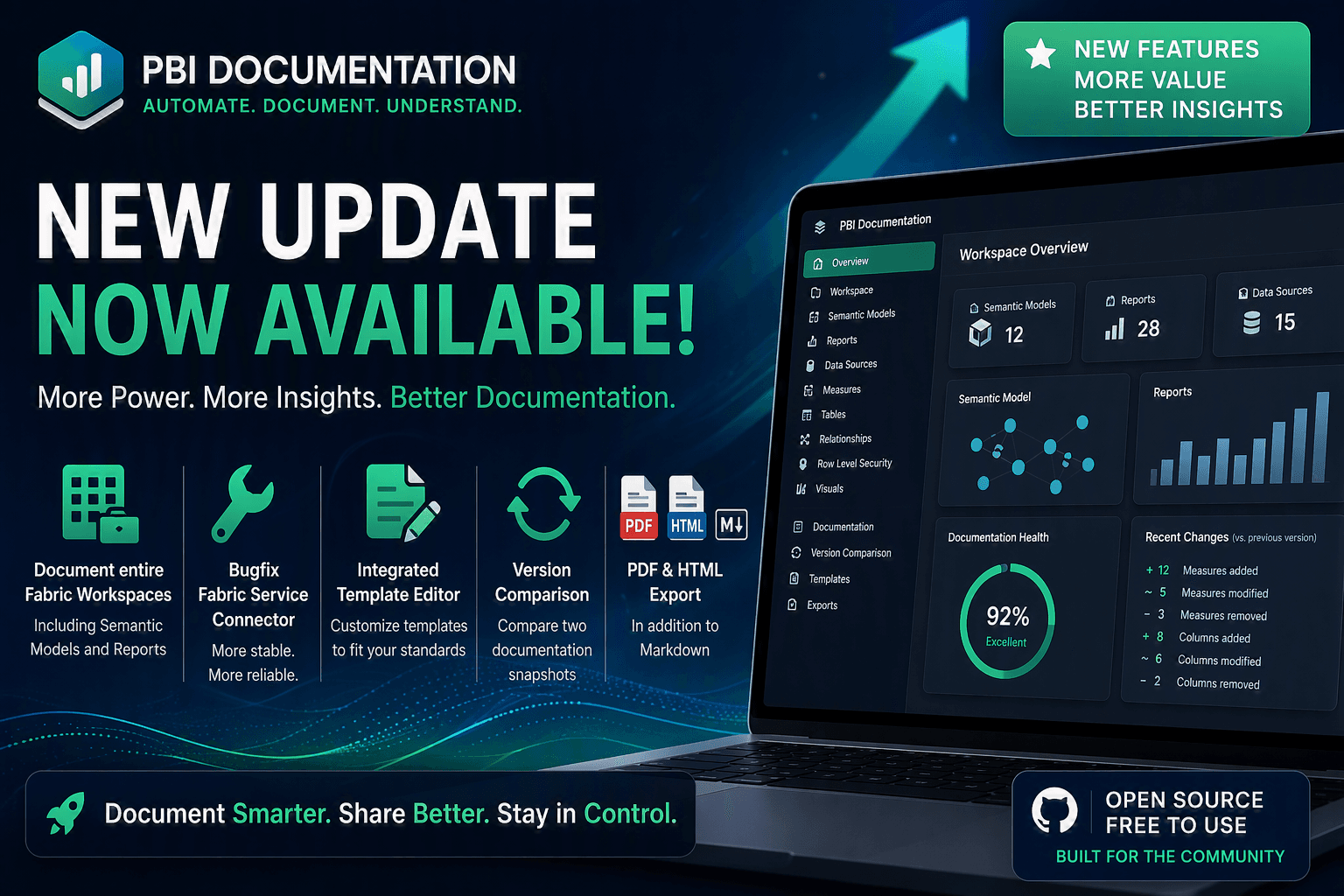
✅ Document Entire Fabric Workspaces
Previously, the tool focused primarily on documenting individual Semantic Models.
With the latest update, you can now document an entire Microsoft Fabric Workspace, including:
- Semantic Models
- Power BI Reports
- Relationships between artifacts
- Workspace metadata
This creates a centralized view of complete analytics solutions rather than isolated components.
🔧 Improved Fabric Service Connector
The Fabric Service Connector has been enhanced with several fixes and stability improvements, providing more reliable connectivity when working with Fabric environments.
✏️ Integrated Template Editor
Every organization has its own documentation standards.
The new built-in template editor allows users to:
- Enable or disable chapters
- Reorganize document sections
- Add custom content
- Adapt documentation to company standards
This makes it easier than ever to align technical documentation with governance and compliance requirements.
🔄 Documentation Version Comparison
Have you ever wondered what changed between two versions of a Semantic Model?
The new version comparison feature automatically detects and highlights differences between documentation snapshots. Changes to tables, measures, metadata, and data sources become immediately visible.
A great addition for:
- Release documentation
- Code reviews
- Audits
- Governance processes
📄 PDF and HTML Export
Markdown export remains available, but users frequently requested additional output formats.
The tool now supports:
- HTML
- Markdown
This allows documentation to be shared more easily across knowledge bases, SharePoint portals, audit processes, and business stakeholders.
Why This Matters
Many Power BI and Fabric solutions still suffer from limited or outdated documentation. The result is often knowledge silos, slow onboarding processes, and increased operational risk.
With these new capabilities, PBI Documentation continues to evolve from a documentation generator into a platform for documentation, governance, and knowledge management across Microsoft Fabric and Power BI environments.
As always, the project remains:
✅ Open Source
✅ Free to use
✅ Available in German and English
✅ Community-driven
I’m looking forward to your feedback, ideas, and feature requests.
How do you currently document your Power BI or Fabric solutions? Which additional features would you like to see next?
#PowerBI #MicrosoftFabric #OpenSource #DataGovernance #BusinessIntelligence #Analytics #DataDocumentation #SemanticModel #DataEngineering #FabricCommunity